

Modern desk work places ongoing stress on the neck and shoulders. Neck and Shoulder Pain from Desk Work often builds gradually, becoming persistent despite regular stretching, massage, or posture changes.
Direct Answers
-
Can desk work cause chronic pain? Yes. Prolonged static loading and repetitive keyboard/mouse use can strain tissues over time.
-
Is posture the only problem? No. While posture matters, tissue capacity, movement variety, and recovery habits are equally critical.
-
Will massage fix the issue? Massage provides short-term relief, but lasting improvement usually requires a movement-based rehab approach.
-
Who is rehab for? Office professionals and remote workers in Markham experiencing recurring stiffness or discomfort.
Table of Contents
- Why Desk Work Strains the Neck and Shoulders
- Common Patterns Behind Desk-Related Pain
- 7 Rehab Strategies for Lasting Relief
- Who This Approach Is (and Isn’t) For
- Frequently Asked Questions
Why Desk Work Strains the Neck and Shoulders
Desk work often involves “static loading,” where muscles must hold the weight of your head and arms in a fixed position for hours. This environment encourages:
- Reduced spinal movement.
- Forward head positioning.
- Lowered engagement of the shoulder blade (scapular) stabilizers.
According to occupational health guidance, even “perfect” ergonomics can lead to strain if movements aren’t varied throughout the day.

Common Patterns Behind Desk-Related Pain
Many patients at our Markham clinic exhibit similar clinical patterns. These include reduced upper back (thoracic) mobility and overactive neck muscles compensating for weak deep-neck stabilizers.
When these patterns persist, the body’s tolerance for sitting decreases. This explains why Neck and Shoulder Pain from Desk Work often returns shortly after a temporary massage or rest.
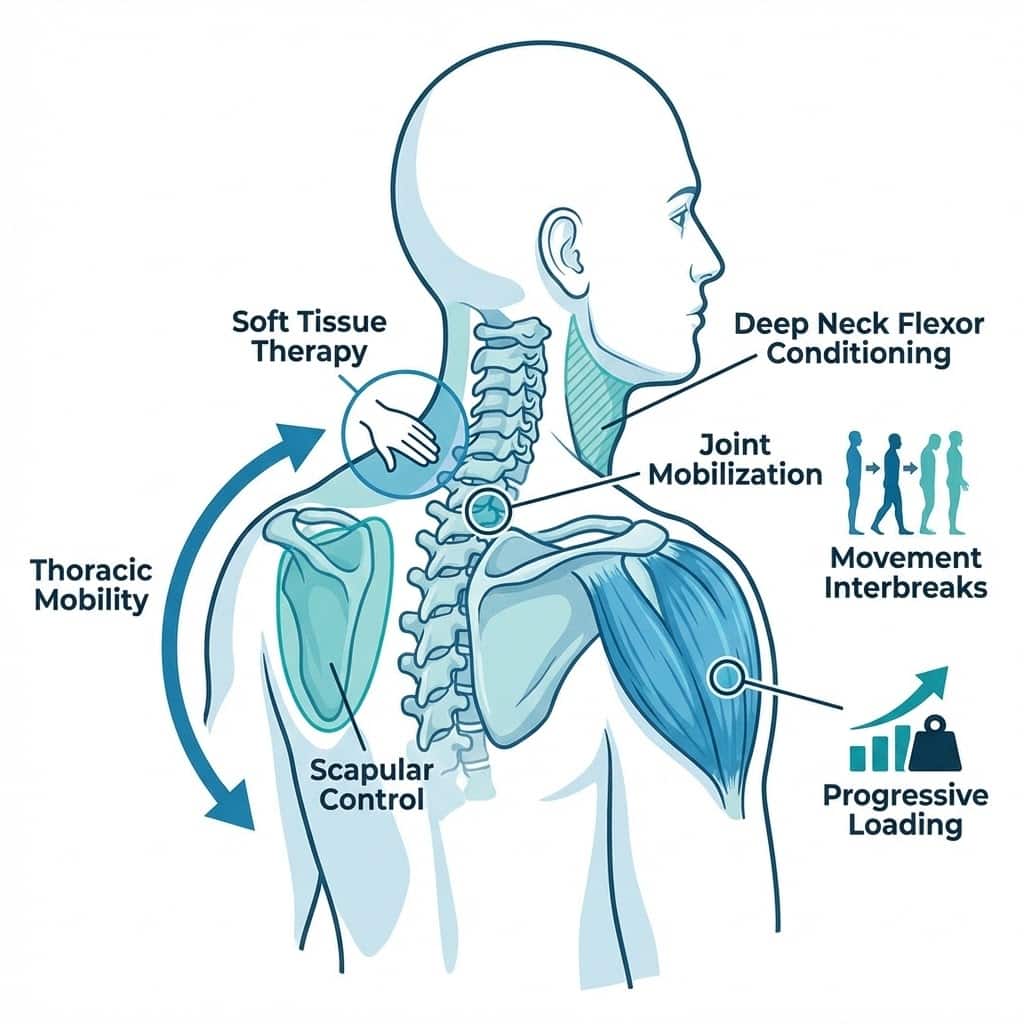
7 Rehab Strategies for Neck and Shoulder Pain from Desk Work
1. Restore Thoracic Mobility
The upper back must move freely to offload the neck. Incorporating rotational movements can significantly reduce the “pull” on the shoulders.
2. Improve Scapular Control
The shoulder blades are the foundation for neck health. Strengthening the muscles that stabilize the scapula helps distribute the load of typing more effectively.
3. Targeted Soft Tissue Therapy
Clinical Soft Tissue Therapy helps reduce muscle “tone” or tension that has become chronic, allowing for better movement during rehab exercises.
4. Precision Joint Mobilization
Rehab-Focused Chiropractic Care uses gentle mobilizations to ensure the joints of the neck and mid-back are moving through their full range without restriction.
5. Deep Neck Flexor Conditioning
Small muscles in the front of the neck often become “inhibited” during desk work. Re-training these muscles provides better internal support for the head.
6. Movement Interbreaks
Instead of a single “posture,” focus on “the next posture.” Changing positions every 30 minutes prevents cumulative tissue creep.
7. Progressive Loading
The final stage of rehab is increasing the endurance of your muscles. This ensures that by the end of an 8-hour workday, your tissues aren’t reaching their breaking point.
Who This Approach Is (and Isn’t) For
This approach may help if you:
- Work at a desk or computer for 4+ hours daily.
- Experience “tension headaches” or stiffness that worsens by 3:00 PM.
- Have tried general stretching without long-term success.
This may not be appropriate if you:
- Experience radiating numbness, tingling, or weakness in the arms.
- Have had a recent acute trauma (e.g., a fall or car accident).
- Require urgent medical diagnostic imaging.
FAQ
How long does rehab usually take?
Timelines vary based on how long symptoms have persisted, but many patients see functional changes within 4 to 6 weeks of consistent care.
Do I need to stop working while in rehab?
Usually, no. Our goal is to improve your capacity to work comfortably, not to remove you from your professional environment.
Can this help with desk-related headaches?
Yes. Improving the function of the upper cervical spine and reducing shoulder tension often reduces the frequency of cervicogenic headaches.
Is this covered by insurance?
Most extended health care plans in Ontario cover Chiropractic and Registered Massage Therapy.
Takeaway
- Desk-related pain is rarely about “bad” posture alone; it is about tissue capacity.
- Neck and Shoulder Pain from Desk Work requires a blend of mobility, strength, and clinical therapy.
- Integrated care addresses the root cause to prevent the cycle of recurring pain.
If desk work is contributing to ongoing discomfort, our Integrated Care Team can help.