
Executive Summary
Your feet are the foundation of every step you take. When one or both feet move differently from how your body can comfortably manage, the ankle, knee, hip, and pelvis may adapt.
Those adaptations do not automatically mean something is “out of alignment.” The body is highly adaptable. But in some people, altered foot function may be one part of a larger movement pattern associated with back or lower-back symptoms.
Research has found associations between certain patterns of foot function, particularly pronated foot function, and low-back pain. However, the relationship is complex, and foot posture alone does not explain every case of back pain. (PubMed Central (PMC))
The practical takeaway is simple: if back pain keeps returning, looking beyond the painful area may be worthwhile.
Table of Contents
Introduction: Your Spine Does Not Move in Isolation
Think about taking a step.
Your foot touches the floor. Your ankle reacts. Your hip and knee adjust. Your pelvis shifts. Your trunk becomes stable.
This movement system is interconnected.
For this reason, rather than focusing solely on the problematic area, a person with back pain may benefit from having their walking pattern, lower-limb mechanics, and general movement evaluated.
At True Integration Wellness in Markham, care is built around an integrated view of movement, mobility and function. The clinic’s approach combines hands-on care with rehabilitation and exercise rather than focusing exclusively on the location of pain. (True Integration Wellness)
What Is Foot Imbalance?
“Foot imbalance” is a broad term. It can refer to differences in how the feet bear weight, move, or interact with the ground.
Examples can include:
- Excessive or poorly controlled pronation
- Differences in weight distribution between the feet
- Changes in arch mechanics
- Limited ankle mobility
- Differences in gait mechanics
- Lower-limb alignment differences
- Foot or ankle weakness following an injury
Importantly, having flat feet or a particular foot shape does not automatically mean you have a problem.
Researchers have found that static foot posture and dynamic foot function do not always tell the same story. One population study, for example, found an association between pronated foot function and low-back pain in women, while static foot posture itself was not associated with low-back pain. (PubMed Central (PMC))
This is one reason a movement assessment can be more informative than judging your feet by appearance alone.
How Can Foot Imbalance Affect Your Spine?
1. Your feet influence the rest of the kinetic chain
When you walk, the motion of your foot transfers to your ankle and lower leg.
Changes farther down the chain can influence how the knee, hip, and pelvis move.
That does not mean a foot problem directly “pushes your spine out of alignment.” Instead, your body may use different movement strategies to maintain balance and forward motion.
While the evidence was moderate and inconsistent, a systematic evaluation found connections between foot pressure and specific measures of spinal posture and movement. (PubMed).
2. Your pelvis may adapt to lower-limb mechanics
The pelvis sits between your legs and spine. If your lower limbs move differently from one side to the other, your pelvis may adapt during standing or walking.
Leg-length differences are one example. Research examining people with leg-length inequality found that insoles appeared to reduce pelvic drop and some spinal compensations when the inequality was moderate or severe. (PubMed)
This does not mean everyone with uneven feet needs an insole. It means the relationship between the feet, pelvis and spine can be clinically relevant in selected cases.
3. Your muscles may work differently
Your nervous system constantly adjusts muscle activity to keep you moving.
Research on foot posture, footwear and orthoses suggests that changes at the foot can alter lower-limb muscle activity and may influence muscle activity higher in the body. (PubMed)
Over time, a particular movement strategy may become your normal pattern.
That may matter when pain, stiffness or reduced mobility is already present.
Foot Pronation, Flat Feet and Back Pain
Pronation is a normal part of foot movement. The concern is not simply whether your foot pronates, but whether the amount, timing, or control of movement is appropriate for your individual body and activity.
Research has reported an association between excessive pronation and mechanical low-back pain, but researchers also emphasize that the relationship needs further investigation. (PubMed)
A newer systematic review of physical interventions for people with chronic low-back pain and pronated feet found improvements in pain and disability in the small group of randomized trials available. Only four studies, however, satisfied the review criteria; thus the results should be taken contextually rather than as evidence that foot therapy is effective for all back pain sufferers. (PubMed)
“Are my feet flat?” is therefore not the crucial question.
It is:
“Is the way my feet function contributing to the way I move?”
Signs Your Feet May Be Affecting Your Movement
Consider an assessment if you notice several of these patterns:
- Back pain that repeatedly returns despite temporary relief
- One shoe wearing differently from the other
- Uneven weight distribution when standing
- Recurrent ankle or knee problems
- Hip or pelvic discomfort during walking
- Noticeable changes in your walking pattern
- Difficulty balancing on one leg
- Foot or ankle stiffness affecting your stride
- Pain that changes with footwear or activity
These signs do not diagnose a foot-related cause of back pain.
They simply suggest that looking at the whole movement chain may provide useful information.
What Can Help?
Start with assessment, not assumptions
The first step is understanding what your body is actually doing.
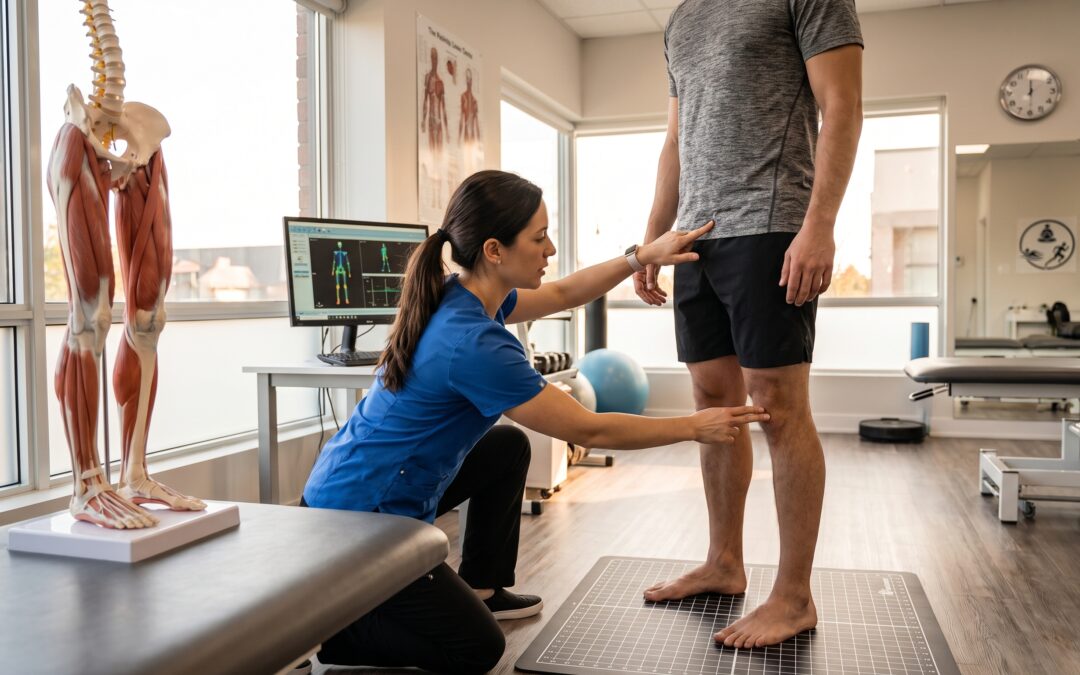
A rehabilitation assessment may consider your symptoms, medical history, mobility, strength, balance, gait, and functional movement.
At True Integration Wellness, the clinic describes its approach as comprehensive and functional, combining hands-on treatment with stretching and strengthening exercises based on individual needs. (True Integration Wellness)
Explore Physical Rehab and other rehabilitation services at True Integration Wellness.
Strength and movement retraining
A customized exercise regimen may help you move better if weakness, limited mobility, or poor movement control are causing your problems.
The goal is not to force your body into a perfect posture.
The goal is to help you move with better control, capacity and confidence.
Consider footwear or orthotic support when appropriate
Although some people may find foot orthoses helpful, they shouldn’t be used as a panacea for back discomfort.
Foot orthoses reduced pain and disability, according to a 2026 meta-analysis of seven randomized trials with 423 participants. However, the researchers observed significant differences between the studies and assessed the overall quality of the evidence as low. (PubMed)
To put it another way, orthotics might be a part of the answer for some people but not necessarily for everyone.
Problem → Solution → Proof → Action
Problem: Your back hurts, but the movement pattern contributing to it may involve more than your back.
Solution: Assess the complete movement chain, including the feet, ankles, knees, hips, and pelvis when clinically appropriate.
Proof: Research demonstrates the complexity of the relationship between specific foot-function patterns, lower-limb mechanics, and low-back symptoms. (PubMed)
Action: Rather than speculating on the cause, think about getting a professional evaluation if persistent back discomfort is interfering with your everyday activities, work, or exercise.
Why Choose an Integrated Approach in Markham?
In Markham, True Integration Wellness offers acupuncture/TCM, massage treatment, spinal decompression, chiropractic adjustments, and physical rehabilitation. Instead of addressing pain in a single place, its stated treatment style focuses on looking at the individual and relevant areas. (True Integration Wellness)
Considering mobility, strength, soft tissue, movement patterns, and functional capacity is crucial for individuals with recurrent back pain; an integrated perspective may prove beneficial.
You do not need to figure out which treatment you need before contacting the clinic. True Integration Wellness offers a free phone consultation to help patients identify an appropriate service and session length. (True Integration Wellness)
Frequently Asked Questions
- Can foot imbalance cause back pain?
Foot function may contribute to back symptoms in some people, but it should not automatically be considered the cause. Research shows associations between certain foot-function patterns and low-back pain, while causation remains more difficult to establish. (PubMed) - Can flat feet affect the spine?
Flat feet do not automatically cause spinal problems. What may matter more is how the foot functions during movement and whether that function is associated with changes elsewhere in the lower limb or pelvis. - Can pronation affect posture?
Foot pronation can be associated with changes in lower-limb mechanics, and research has investigated relationships between foot function and spinal posture. The effect varies between individuals. (PubMed) - Can orthotics help lower-back pain?
They may help some people. Current research suggests potential benefits, but evidence quality and study results vary. Orthotics should therefore be considered based on an individual’s assessment rather than used automatically for every case of back pain. (PubMed) - Should I have my feet assessed if I have recurring back pain?
It can be reasonable, particularly when symptoms occur alongside gait changes, ankle or foot problems, uneven weight bearing, or recurring lower-limb issues. A clinician can determine whether the feet appear relevant to your individual movement pattern. - Do I need to know which treatment to book?
No. True Integration Wellness states that patients can begin with a free phone consultation if they are unsure which service is appropriate. (True Integration Wellness)
Conclusion: Look Beyond Where It Hurts
Your feet may be small, but they interact with every step you take.
Foot function can influence the mechanics of the ankle, knee, hip and pelvis, and these relationships may be relevant when someone is experiencing recurring low-back symptoms. At the same time, foot imbalance is only one possible contributor to back pain.
The best approach is not to blame your feet or your spine.
It is to understand how your whole body moves.
If you are in Markham and dealing with recurring back pain, stiffness or movement limitations, True Integration Wellness can help you start with an individualized assessment and determine what type of care fits your needs.
Your feet are your foundation. Your movement tells the story.
Book a Free Consultation with True Integration Wellness
References
- Kendall JC, et al. Foot posture, leg length discrepancy and low back pain: their relationship and clinical management using foot orthoses: an overview. Foot. (PubMed)
- Lin Z, et al. Effect of foot orthoses on pain and disability in patients with low back pain: a meta-analysis of randomized controlled trials. Disability and Rehabilitation, 2026. (PubMed)
- Effects of physical interventions on pain and disability in chronic low back pain with pronated feet: a systematic review and meta-analysis. (PubMed)
- Menez C, et al. Effects of Insoles on Gait Kinematics and Low Back Pain in Patients with Leg Length Inequality: A Systematic Review. (PubMed)
- Relationship between foot pressure and spinal parameters in healthy adults: A systematic review. (PubMed)
- Association between lower limb alignment and low back pain: A systematic review with meta-analysis. (PubMed Central (PMC))
Internal-Link Architecture
- Physical rehabilitation: /services/
- Integrated care: /blog/integrated-care/
- Integrated rehabilitation in Markham: /blog/integrated-rehab-markham/
- Chiropractic/movement care: relevant existing chiropractic service page
- Spinal decompression: relevant existing service page
- Contact/booking: /contact-us/
The existing site already positions physical rehabilitation around restoring strength, mobility, and function, while its integrated-care content emphasizes looking at the whole person rather than an isolated painful area. (True Integration Wellness)
External Authority Links
Recommended authoritative outbound references:
- PubMed research on foot posture and low-back pain
https://pubmed.ncbi.nlm.nih.gov/41166129
- PubMed systematic review/meta-analysis on foot interventions
https://pubmed.ncbi.nlm.nih.gov/37431167
- PubMed systematic review on insoles and leg-length inequality
https://pubmed.ncbi.nlm.nih.gov/37134059
- Peer-reviewed systematic review on foot pressure and spinal parameters
https://www.researchgate.net/publication/370567922_Relationship_between_foot_pressure_and_spinal_parameters_in_healthy_adults_-_A_systematic_review