

Executive Summary
Frozen shoulder (adhesive capsulitis) causes progressive pain, stiffness, and restricted range of motion in the shoulder joint. Left unmanaged, recovery can take up to three years. A targeted, stage-specific physiotherapy plan reduces pain, preserves joint capsule mobility, and accelerates your return to daily activities. This blog details the condition’s progression, evidence-based rehab exercises, and personalized physical therapy solutions available in Markham, ON.
Purpose and Scope
This blog provides patients and caregivers with clear, clinically backed information regarding adhesive capsulitis. It outlines safe exercise protocols, highlights critical diagnostic distinctions, and demonstrates how manual physical therapy and modality-based care restore shoulder performance safely.
Understanding Frozen Shoulder
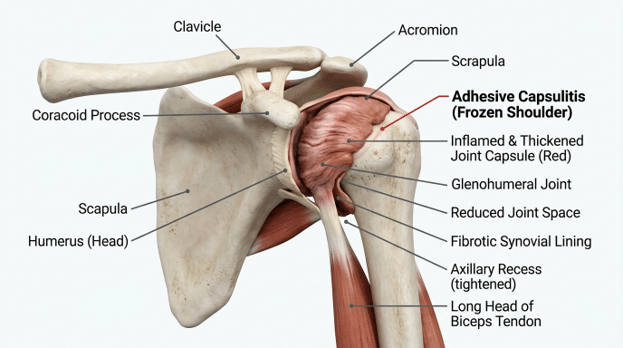
Adhesive capsulitis occurs when the strong connective tissue surrounding the shoulder joint (the shoulder capsule) becomes thick, tight, and inflamed. This capsule limits the movement of the humerus (upper arm bone) within the socket, causing severe pain and stiffness during both active movement and passive manipulation.
Start With Assessment, Not Assumptions
1. Problem
Self-diagnosing shoulder stiffness often leads to improper treatment. Aggressive stretching during the early inflammatory phase can worsen tissue inflammation and intensify pain.
2. Solution
A comprehensive clinical assessment differentiates adhesive capsulitis from conditions with similar symptoms, such as rotator cuff tears, shoulder impingement, or cervical radiculopathy.
3. Proof
Clinical research confirms that stage-matched physical therapy interventions lead to higher patient satisfaction, better functional outcomes, and lower pain scores compared to unguided stretching routines.
4. Action
Book a one-on-one mechanical shoulder assessment with a registered physiotherapist before starting any intensive rehab program.
The 3 Clinical Stages of Frozen Shoulder
Stage 1: The Freezing Stage (2 to 9 Months)
- Pathology: Acute inflammatory phase causing progressive tightening of the glenohumeral joint capsule.
- Primary Symptoms: Severe, diffuse shoulder pain that worsens at night and when sleeping on the affected side; gradual reduction in range of motion.
- Primary Rehab Focus: Pain control, gentle passive range-of-motion exercises, inflammation management, and avoiding aggressive stretching that triggers capsular spasm.
Stage 2: The Frozen Stage (4 to 12 Months)
- Pathology: Active inflammation subsides, but capsular fibrosis and collagen proliferation reach peak density.
- Primary Symptoms: Sharp pain decreases slightly, but severe stiffness sets in; daily activities like reaching overhead, dressing, or fastening a seatbelt become significantly restricted.
- Primary Rehab Focus: Stage-matched joint mobilizations, low-intensity prolonged passive stretching, and maintaining surrounding scapular muscle function without re-inflaming the capsule.
Stage 3: The Thawing Stage (6 to 24 Months)
- Pathology: Spontaneous resolution of capsular tightness as fibrotic tissue re-absorbs and remodels.
- Primary Symptoms: Steady, progressive return of shoulder range of motion; functional strength gradually improves as joint restriction releases.
- Primary Rehab Focus: Progressive resistance training, end-range mobility recovery, and functional movement retraining to restore complete upper-body biomechanics.
Targeted Rehab Plan: Stage-By-Stage Exercises
Perform these exercises only within a pain-free or mildly uncomfortable range. Never force a joint through sharp pain.
Phase 1: Gentle Mobility & Pain Control (Freezing Stage)
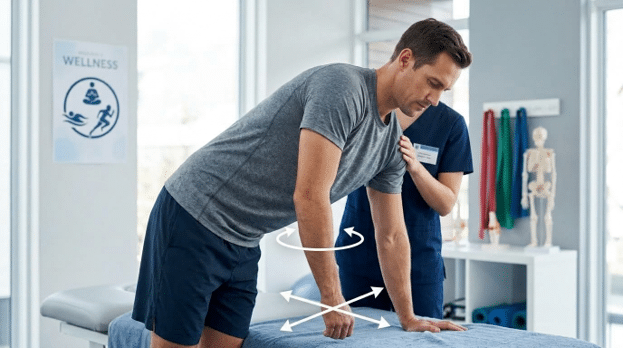
Pendulum Stretch
- Lean forward and support your non-affected arm on a sturdy table.
- Let your affected arm hang straight down toward the floor.
- Gently swing the hanging arm in small circles using momentum from your torso.
- Perform 10 small circles clockwise and counter-clockwise.
Cross-Body Reach
- Sit or stand comfortably.
- Use your strong arm to lift your affected arm at the elbow.
- Bring it up and across your body, applying gentle pressure to stretch the back of the shoulder.
- Hold for 15–20 seconds; repeat 3 times.
Phase 2: Range-of-Motion Recovery (Frozen Stage)
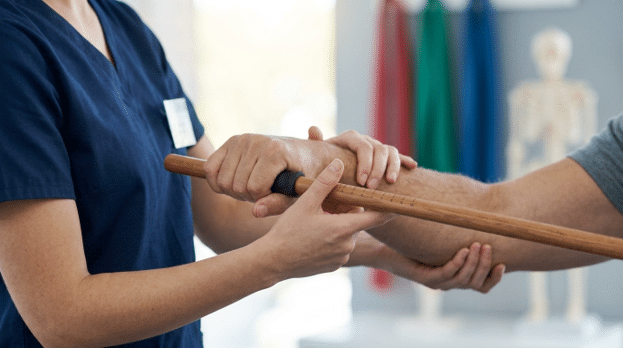
Wand / Cane External Rotation
- Lie on your back holding a cane or lightweight wand with both hands, elbows bent at 90 degrees.
- Keep your affected elbow close to your side.
- Use your healthy arm to push the wand horizontally, rotating the affected forearm outward.
- Hold the end range for 10–15 seconds; repeat 10 times.
Towel Stretch (Internal Rotation)
- Hold one end of a hand towel behind your back with your healthy arm over your shoulder.
- Grab the bottom end of the towel behind your lower back with your affected arm.
- Gently pull the towel upward with your top arm to stretch the bottom arm up your back.
- Hold for 15 seconds; repeat 5 times.
Phase 3: Dynamic Strengthening & Functional Integration (Thawing Stage)
Scapular Retraction (Squeeze)
- Stand upright with arms at your sides.
- Squeeze your shoulder blades back and downward together without shrugging your shoulders.
- Hold for 5 seconds; release. Perform 2 sets of 10 repetitions.
Wall Crawl / Finger Ladder
- Face a wall at arm’s length.
- Touch the wall with the fingertips of your affected arm at waist level.
- Slowly walk your fingers up the wall as high as comfortable without arching your back.
- Lower the arm slowly; repeat 5-8 times.
Why Professional Physiotherapy Matters
While home exercises maintain movement, clinical physical therapy corrects underlying biomechanical compensations.
- Targeted Manual Therapy: High-grade passive joint mobilizations stretch the deep joint capsule beyond what self-stretching can achieve.
- Acupuncture & Dry Needling: Reduces myofascial trigger points in compensation zones (trapezius, levator scapulae).
- Laser & Modality Therapy: Accelerates cellular repair and decreases acute inflammation in the joint capsule.
- Movement Retraining: Corrects abnormal scapulothoracic rhythm to prevent secondary neck or upper back strain.
Why Choose True Integration Wellness in Markham?
At True Integration Wellness, we don’t apply generic treatment templates. We combine evidence-based physical therapy with precise, patient-centered care plans tailored to your specific recovery stage.
- Comprehensive One-on-One Assessments: We identify the exact stage of capsular restriction and rule out secondary pathologies.
- Integrated Care Models: Access combined treatments including registered physiotherapy, chiropractic care, and acupuncture under one roof.
- Direct Billing & Convenient Location: Conveniently located at Highway 7 and Birchmount in Markham with full direct billing support.
Frequently Asked Questions
- How long does frozen shoulder last without physical therapy?
Unmanaged adhesive capsulitis can persist for 2 to 3 years or longer. Professional physiotherapy helps preserve functional range of motion and often significantly reduces overall recovery timelines. - Is it safe to exercise a frozen shoulder?
Yes, but exercises must match your current stage. Pushing through severe, sharp pain during Stage 1 can worsen joint inflammation. Always work within a pain-monitored boundary guided by a physical therapist. - What triggers frozen shoulders?
It often develops after a period of joint immobilization (due to injury, surgery, or stroke). Systemic conditions such as diabetes, thyroid dysfunction, and cardiovascular disease also significantly increase risk. - How can I tell frozen shoulders apart from a rotator cuff injury?
Frozen shoulder causes equal loss of motion in both active (self-moved) and passive (moved by a therapist) movements due to capsular restriction. Rotator cuff tears primarily cause pain and weakness during active movements, while passive motion remains relatively intact. - Can massage therapy fix frozen shoulders?
Massage therapy relieves muscle tension in surrounding compensators (e.g., upper traps, neck, upper back), but it cannot release the deep fibrous joint capsule alone. It works best when combined with physical therapy joint mobilizations. - Do I need an X-ray or MRI to diagnose a frozen shoulder?
Adhesive capsulitis is primarily a clinical diagnosis based on physical examination and movement loss history. However, imaging like X-rays or MRIs may be used to rule out arthritis or major tendon tears. - How often should I perform shoulder rehab exercises?
In early stages, perform gentle mobility exercises 2 to 3 times daily in short sessions. During strengthening phases, exercises are typically performed 3 to 4 times per week to allow proper muscle recovery.
References
- American Academy of Orthopaedic Surgeons (AAOS): Adhesive Capsulitis (Frozen Shoulder) Clinical Management Guidelines.
- Journal of Orthopaedic & Sports Physical Therapy (JOSPT): Shoulder Pain and Mobility Deficits: Adhesive Capsulitis (2013 Clinical Practice Guidelines).
- Mayo Clinic: Frozen Shoulder Diagnosis and Treatment Protocols.
Internal-Link Architecture
- Physical therapy solutions: https://trueintegrationwellness.ca/physical-rehab/
- Acupuncture & Dry Needling: https://trueintegrationwellness.ca/acupuncture-tcm/
- True Integration Wellness: https://trueintegrationwellness.ca/
- Schedule your comprehensive shoulder assessment today: https://trueintegrationwellness.ca/booking/
External Authority Links
- The 3 Clinical Stages of Frozen Shoulder: https://www.mayoclinic.org/diseases-conditions/frozen-shoulder/symptoms-causes/syc-20372684
- Understanding Frozen Shoulder: https://www.jospt.org/doi/10.2519/jospt.2009.2916
Next Steps & Recovery Plan
Don’t let shoulder stiffness restrict your everyday life. Safe, stage-matched recovery begins with an accurate clinical assessment.
Take Action Today:
- Address: 3601 Hwy 7 Unit 708, Markham, ON L3R 0M3, Canada
- Website: True Integration Wellness
- Action: Schedule your comprehensive shoulder assessment today and start your personalized recovery path.